Monday, February 19, 2007

"Apologeia Mea Culpa" as Successful Argument

Mea culpa to Bush on Presidents Day
Plain Talk by Al Neuharth, USA TODAY founder (2-16-07)

Our great country has had 43 presidents. Many very good. A few pretty bad. On Presidents Day next Monday, it's appropriate to commemorate them all.

I remember every president since Herbert Hoover, when I was a grade school kid. He was one of the worst. I've personally met every president since Dwight Eisenhower. He was one of the best.

A year ago I criticized Hillary Clinton for saying "this (Bush) administration will go down in history as one of the worst."

"She's wrong," I wrote. Then I rated these five presidents, in this order, as the worst: Andrew Jackson, James Buchanan, Ulysses Grant, Hoover and Richard Nixon. "It's very unlikely Bush can crack that list," I added.

I was wrong. This is my mea culpa. Not only has Bush cracked that list, but he is planted firmly at the top.

The Iraq war, of course, has become Bush's albatross. He and his buddies are great at coining words or slogans. "Bushisms" that will haunt him historically:

  • "Shock and Awe," early 2003.

  • "Mission Accomplished," May 1, 2003.

  • "Stay the Course," June 2003, 2004, 2005, 2006.

  • "New Strategy," 2007.

Another term historians may weigh critically is "Decider."

Is he just a self-touted decider doing what he thinks right? Or is he an arrogant ruler who doesn't care or consider what the public or Congress believes best for the country?

Despite his play on words and slogans, Bush didn't learn the value or meaning of mea culpa (acknowledgement of an error) during his years at Yale.

Bush admitting his many mistakes on Iraq and ending that fiasco might make many of us forgive, even though we can never forget the terrible toll in lives and dollars.

Feedback: Other views on Bush presidency

"Just as we don't stop football games after three quarters, we shouldn't judge the historical place of presidents when they've still got nearly two years in office."

— John J. Miller, political reporter, National Review

"Unless there is some great reversal, Bush will be seen as one of the country's poorest presidents. Iraq will stand at the top of the list, but the administration's failed responses to Katrina and global warming will stand with its abuse of civil liberties to mark Bush out as a man with poor judgment and a failed leader."

— Robert Dallek, historian; his new book, Nixon and Kissinger: Powers in Power, will be published in April.

---------------------------------------------------


Response by Duly Consider Editor Bryan E. Hall

It is unusual to see someone treat an apology via mea culpa as an "argument", but it does have a logical cause and effect characteristic. You should note "wrong" is a moral term most often but in this case he meant "incorrect" in retrospect.

The fallacy with Neuharth's reasoning was that he assumed there was an objective way to measure how "bad" Bush really is. Bush is clearly bad for those who died or lost money and suffered pain and worry; but Bush has been the best President in history for raising the income of the upper 10% of Americans and for advancing the cause of Nazi/Fascism.

He has been successful at doing what he intended to do, which was to turn back the clock on civil rights and the US position of "a brother among nations". He may be even more successful if allowed to go unchecked and get us into another war that we can't get out of, in Iran. He has been more successful than his brother Neil was when he intentionally made bad loans knowing the Feds would bail him out and allow him to keep his profits.

Young Bush has been more successful than his father, which takes a lot considering the first Bush started a war with Nicaragua and simply got out of it by saying, "No I didn't," and by leading the assassination of JFK and claiming he wasn't even in the CIA at the time, which was a lie and by selling the weapons that Iran is giving insurgents in Iraq to kill US soldiers today.

As a President "W" has realized the incredible power of the Presidency in foreign affairs and his ability to act from the "bully pulpit" with impunity and to claim executive privilege until congress has the balls to stop him. As a helper of the US people he has utterly failed, but that's assuming it was his goal to help the masses that didn't even elect him. He has succeeded at not only giving hundreds of billions of government money to his friends and building a debt so that his buddies will continue to benefit long after he is gone.

I guess it depends on who you ask. His friends would say he will go down as their best President. And isn't that what it's all about?

Wednesday, February 14, 2007

US Troop Surge Clearly Intended for Show of Force to Iran


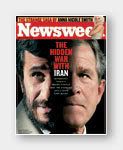
In a shocking preview of the Newsweek article that will appear in Newsweek on February 19th it is foretold how likely a confrontation with Iran is.

Ex-Senator Max Cleland appears on CNN warns us that we are leading to a dangerous position with "no mission and no purpose" and that the best way to "support our soldiers is to bring them home" from a war that has no chance of benefiting American interests other than those of the military industrial complex. Impassioned, he warns that the congress must "put up or shut up" in reference to their responsibility to clearly exercise their constitutional duty to declare war and to un-declare it. Cleland, in his righteous passion as one who has lost many limbs, suggests he finds no difficulty in getting emotional about this when he sees soldiers like himself in VA hospitals, permanently handicapped physically and mentally.

Bush speaks as if there is a clear necessity and that he plans to do whatever he believes is right assuming the congress doesn't stop him saying, "I'm gonna do something about it."

Hillary Clinton supports a clear statement of prevention of attack on Iran without Congressional approval.

The fact is, short of such clear legal limitations, Bush is quite capable of writing a check that we can't pay as if he hasn't already broke the bank. As US President, he is in a position of placing us in a position that creates irrevocable damage to relations and American lives and limbs, not to mention further massacre and maiming of Mid-easterners.

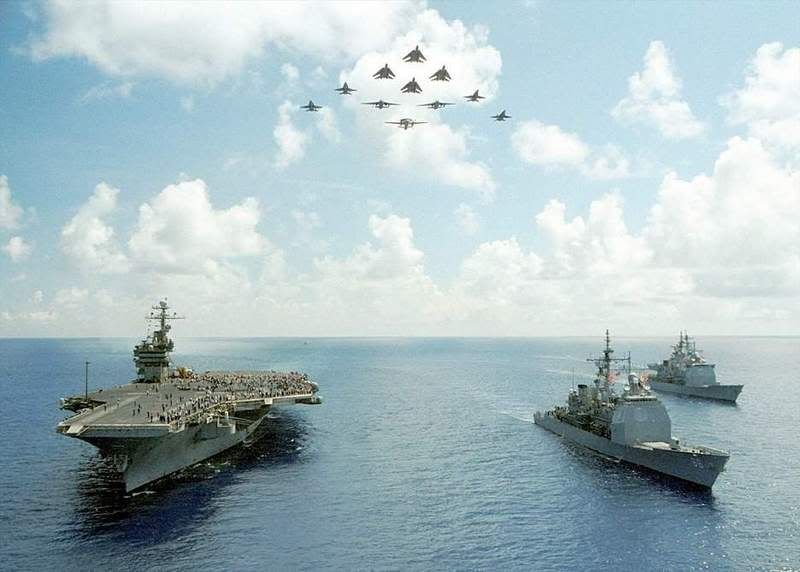
The Navy is steaming ahead. President Bush's proposed “surge” of 21,500 more troops in Iraq will mean extended deployments for thousands of Southern California sailors (one of which is my Navy officer nephew, and all are someone's loved ones) and Marines, military officials said Thursday.

The Camp Pendleton-based 15th Marine Expeditionary Unit – a 2,200-member special-operations contingent that includes a helicopter squadron from Miramar Marine Corps Air Station – will stay an extra 45 days in Iraq, said Lt. Ted Vickers, a Marine Corps spokesman.

It appears that Bush may not even consider the Navy deployment to be part of his announced 21,500. But ask any of the wives if there is a difference between their husbands staying in San Diego and living on a ship off the Iranian coast and you will hear the emotional truth. Financially, it certainly cost the US more to station ships there as opposed to home. Clearly, a Naval presence has no purpose in supporting the efforts in Iraq, so this adds to the legitimate paranoia of Iran.

Bush likes to think of himself as a "man of action" but the actions are always of others. His family will not suffer, nor will his friends. In fact, he and VP Cheney have made their social circles of almost exclusively those who benefit from maintaining war instead of seeking peace. As it stands, those that suffer disproportionately are the poor and middle class.

If Congress does not act now, preemptively, we may soon see an Armageddon never fully envisioned by biblical prophets. Whatever bible one reads, we can all agree that this war is not consistent with the standards stated in any major religion; Yet, here we are being led by the squeaky wheels purporting themselves to be moral.


Monday, February 12, 2007

Unqualified US Kings Placed in Baghdad Palaces-- Sucking Down US Taxpayer Dollars --Avoiding Solutions


Imperial Life in the Emerald City:
Inside Iraq's Green Zone

By Rajiv Chandrasekaran
(excerpt from Amazon)

An unprecedented account of life in Baghdad’s Green Zone, a walled-off enclave of towering plants, posh villas, and sparkling swimming pools that was the headquarters for the American occupation of Iraq.

The Washington Post’s former Baghdad bureau chief Rajiv Chandrasekaran takes us with him into the Zone: into a bubble, cut off from wartime realities, where the task of reconstructing a devastated nation competed with the distractions of a Little America—a half-dozen bars stocked with cold beer, a disco where women showed up in hot pants, a movie theater that screened shoot-’em-up films, an all-you-could-eat buffet piled high with pork, a shopping mall that sold pornographic movies, a parking lot filled with shiny new SUVs, and a snappy dry-cleaning service—much of it run by Halliburton. Most Iraqis were barred from entering the Emerald City for fear they would blow it up.

Drawing on hundreds of interviews and internal documents, Chandrasekaran tells the story of the people and ideas that inhabited the Green Zone during the occupation, from the imperial viceroy L. Paul Bremer III to the fleet of twentysomethings hired to implement the idea that Americans could build a Jeffersonian democracy in an embattled Middle Eastern country.

In the vacuum of postwar planning, Bremer ignores what Iraqis tell him they want or need and instead pursues irrelevant neoconservative solutions—a flat tax, a sell-off of Iraqi government assets, and an end to food rationing. His underlings spend their days drawing up pie-in-the-sky policies, among them a new traffic code and a law protecting microchip designs, instead of rebuilding looted buildings and restoring electricity production. His almost comic initiatives anger the locals and help fuel the insurgency.

Chandrasekaran details Bernard Kerik’s ludicrous attempt to train the Iraqi police and brings to light lesser known but typical travesties: the case of the twenty-four-year-old who had never worked in finance put in charge of reestablishing Baghdad’s stock exchange; a contractor with no previous experience paid millions to guard a closed airport; a State Department employee forced to bribe Americans to enlist their help in preventing Iraqi weapons scientists from defecting to Iran; Americans willing to serve in Iraq screened by White House officials for their views on Roe v. Wade; people with prior expertise in the Middle East excluded in favor of lesser-qualified Republican Party loyalists. Finally, he describes Bremer’s ignominious departure in 2004, fleeing secretly in a helicopter two days ahead of schedule.

This is a startling portrait of an Oz-like place where a vital aspect of our government’s folly in Iraq played out. It is a book certain to be talked about for years to come.

Related Posts with Thumbnails